



A journey from hope to reality—understanding the distance, danger, and limits of interstellar travel
A Star That Feels Close… But Isn’t
Somewhere in the vast darkness of space, beyond every planet we’ve explored, there is a small, quiet star. It doesn’t shine brightly in our sky. It doesn’t guide travelers or light up the night. And yet, it holds a special place in our universe. Because it is the closest star to Earth. That star is Proxima Centauri. At first, the idea feels comforting—the closest star. It sounds like something we might reach one day. But space has a way of turning simple words into something much bigger than we expect.Because in the universe, “close” doesn’t mean what we think it does.
How Far Is the Closest Star?
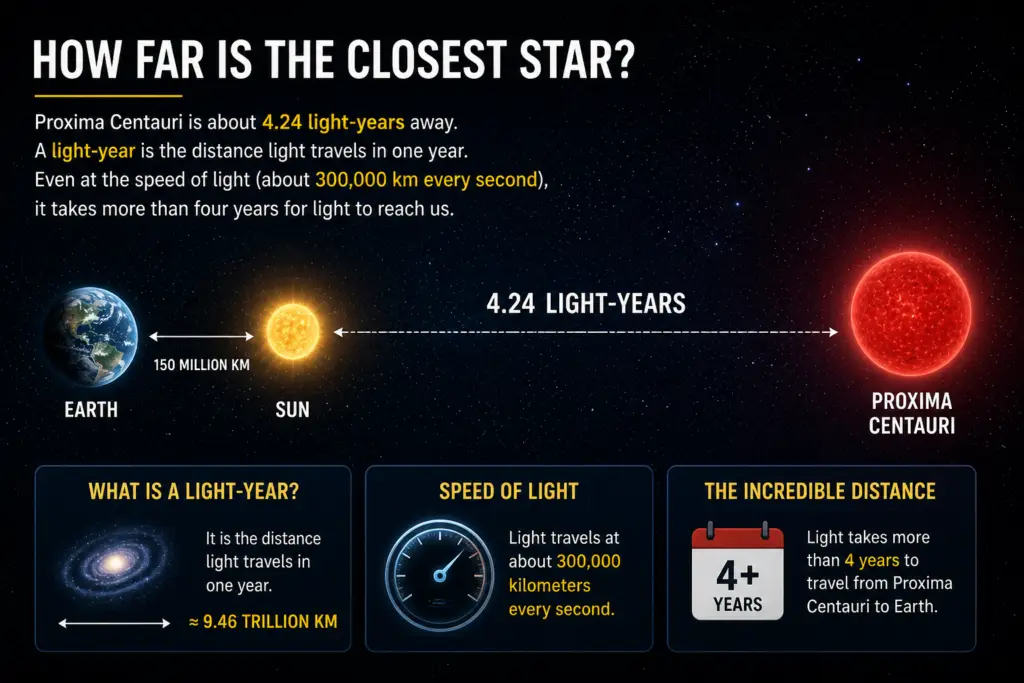
Proxima Centauri is about 4.24 light-years away. That number sounds small—until you understand what a light-year really means. A light-year is the distance light travels in one year. And light moves faster than anything in the universe—about 300,000 kilometers every second. Even at that incredible speed, it takes more than four years just for light to travel from Proxima Centauri to Earth. Now imagine trying to make that journey with human technology.
Why We Still Can’t Reach It
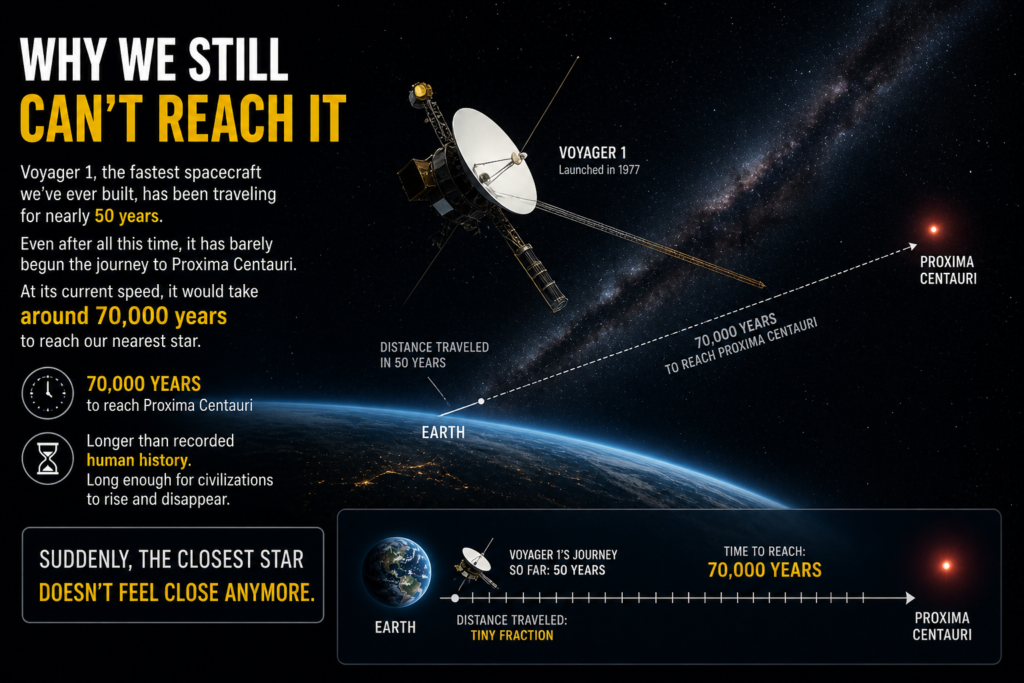
The fastest spacecraft ever built by humans, Voyager 1, has been traveling through space for nearly 50 years. And even after all that time, it has barely begun the journey. At its current speed, it would take around 70,000 years to reach Proxima Centauri. That’s longer than recorded human history. Long enough for civilizations to rise and disappear. Suddenly, the closest star doesn’t feel close anymore.
A Star Very Different from Our Sun
Proxima Centauri is not like our Sun. It is a red dwarf, much smaller and dimmer, producing only a fraction of the energy our Sun gives us. If our Sun were replaced by Proxima, Earth would fall into a dim, reddish twilight. The warmth that supports life would disappear, and our planet would slowly freeze. But what makes this star even more unusual is its behavior. It is not calm. It is violent.
A Star That Erupts with Power
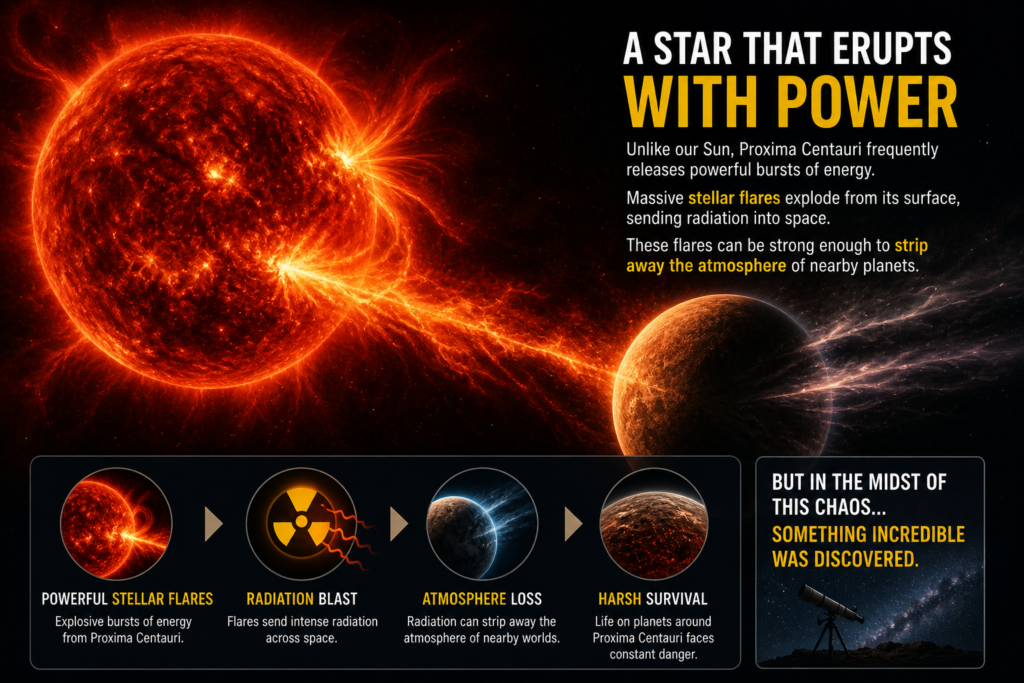
Unlike our Sun, Proxima Centauri frequently releases powerful bursts of energy. Massive stellar flares explode from its surface, sending radiation into space. These flares can be strong enough to strip away the atmosphere of nearby planets.For any world orbiting this star, survival would be a constant struggle.And yet, despite this chaos, something incredible was discovered.
Proxima Centauri b: A World Like Earth?
In 2016, scientists discovered a planet orbiting this nearby star. It was named Proxima Centauri b. This planet is rocky, similar in size to Earth, and it exists in what scientists call the habitable zone—a region where temperatures might allow liquid water to exist. For the first time, the closest star wasn’t just a distant object. It became a possible destination.
A World Between Fire and Ice
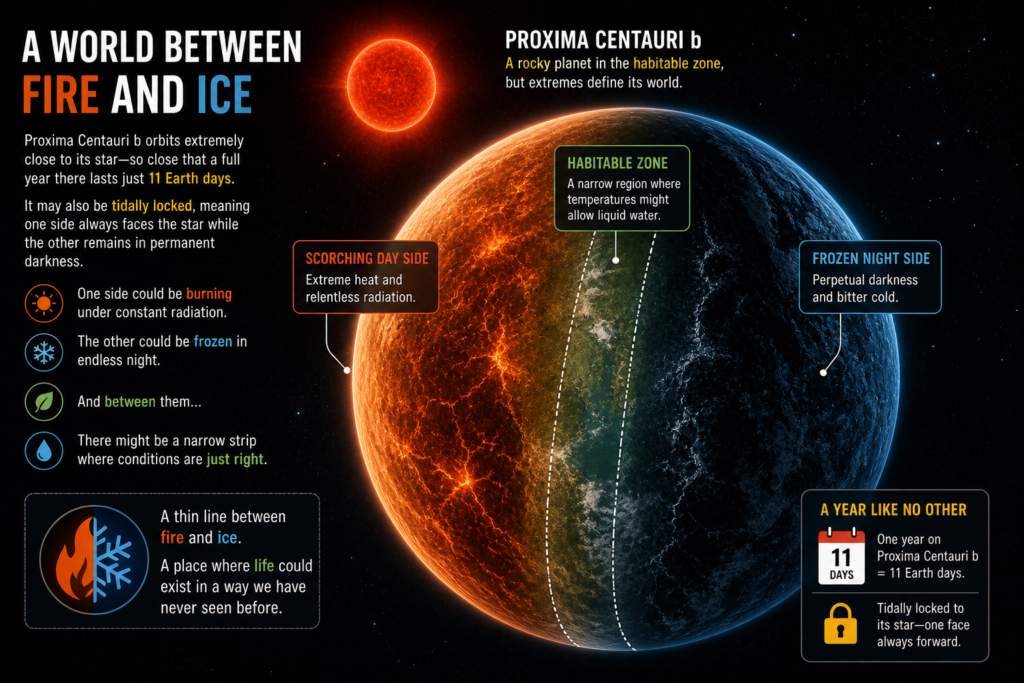
But this planet is far from perfect. Proxima Centauri b orbits extremely close to its star—so close that a full year there lasts just 11 Earth days. It may also be tidally locked, meaning one side always faces the star while the other remains in permanent darkness. One side could be burning under constant radiation. The other could be frozen in endless night. And between them…There might be a narrow strip where conditions are just right. A thin line between fire and ice. A place where life could exist in a way we have never seen before.
The Real Challenge: Getting There
Even if Proxima Centauri b is habitable, one major problem remains. Getting there. To reach another star within a human lifetime, we would need to travel at a significant fraction of the speed of light. And that creates new dangers. At such speeds, even tiny dust particles in space become deadly. A grain of dust could hit with explosive force. Space may look empty—but at high speed, it becomes extremely dangerous.
The Limits of the Human Body
Even if we solve the engineering challenges, there is another problem. Us. Humans are not built for long journeys through deep space. Radiation, isolation, and psychological stress would all take a serious toll. A journey to another star wouldn’t just be a mission. It would be a one-way life.
The Future: Machines Before Humans
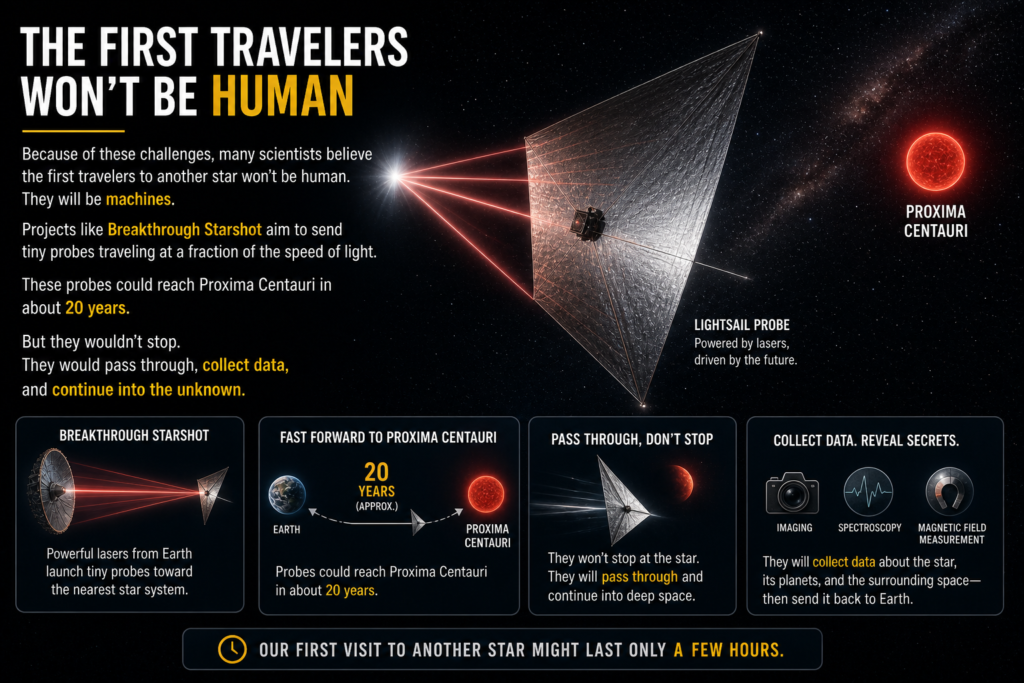
Because of these challenges, many scientists believe the first travelers to another star won’t be human. They will be machines. Projects like Breakthrough Star shot aim to send tiny probes traveling at a fraction of the speed of light. These probes could reach Proxima Centauri in about 20 years. But they wouldn’t stop. They would pass through, collect data, and continue into the unknown.Our first visit to another star might last only a few hours.
Why Proxima Centauri Matters
Proxima Centauri is more than just the closest star. It is a symbol. It represents the boundary between what humanity can do today—and what it might achieve in the future.It reminds us that space is vast, and we are only at the beginning of our journey.
A Final Thought
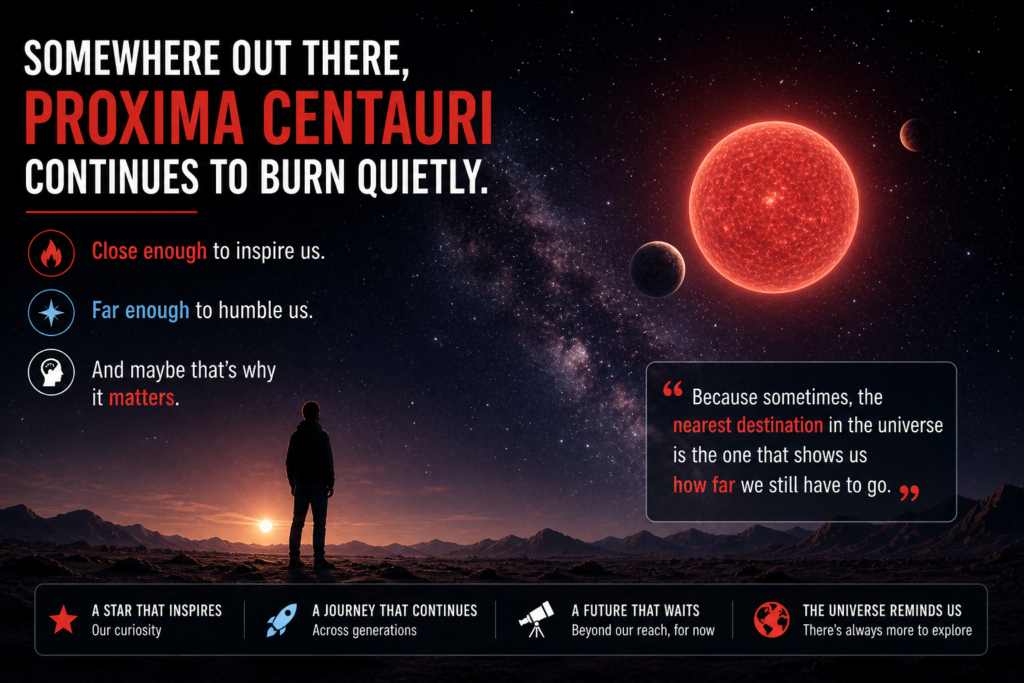
Somewhere out there, Proxima Centauri continues to burn quietly. Close enough to inspire us. Far enough to humble us. And maybe that’s why it matters. Because sometimes, the nearest destination in the universe is the one that shows us how far we still have to go.