


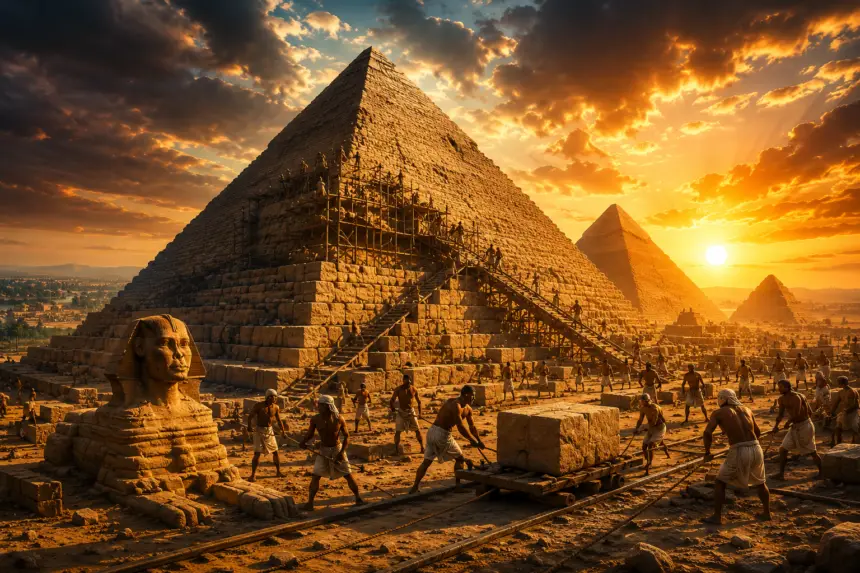
The Egyptian Pyramids: How Did People Build Something This Impossible 4,500 Years Ago?
Imagine standing in the middle of the Egyptian desert 4,500 years ago.
No machines.
No cranes.
No bulldozers.
Not even wheels.
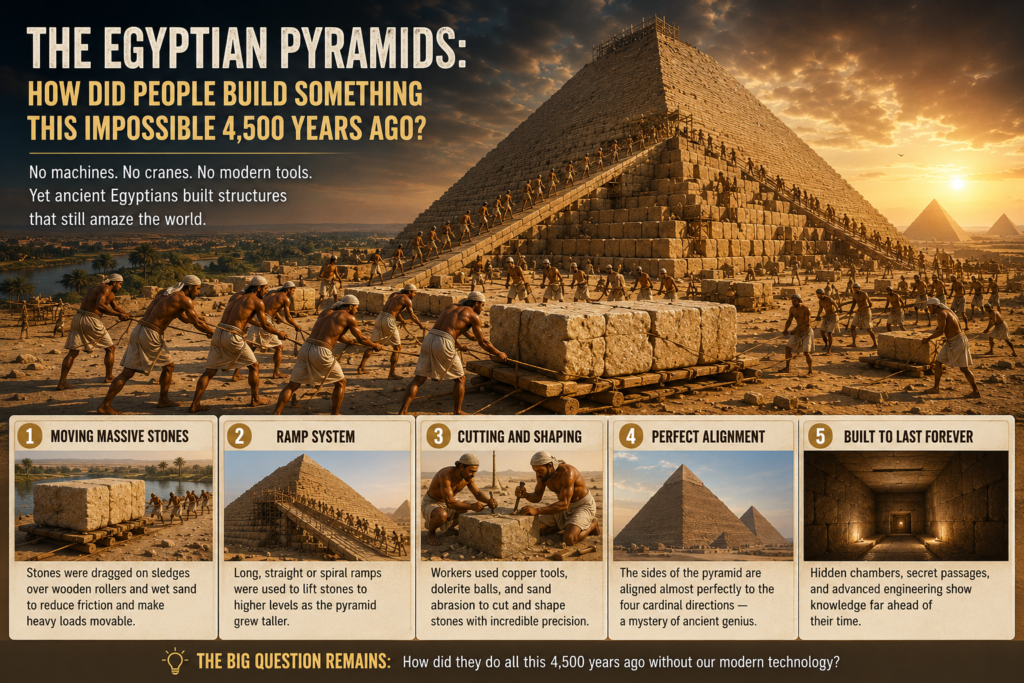
Just sand… heat… stone… and thousands of people trying to build something that would survive forever. Now here’s the part that still confuses scientists today. The Great Pyramid of Giza was built using more than 2 million stone blocks. Some of these stones weighed as much as a truck. And somehow, ancient Egyptians managed to cut them, transport them, lift them, and place them with unbelievable precision. Even today, modern engineers look at the pyramids and quietly ask the same question: How did they actually do this?
More Than Just a Tomb
To understand the pyramids, we first need to understand how ancient Egyptians saw life itself. For them, death wasn’t the end. They believed the soul continued its journey after death. And because of that belief, preserving the body became extremely important. That’s why Egyptians developed mummification — one of the most fascinating rituals in human history. When a pharaoh died, Egyptians didn’t simply bury him. They prepared him for eternity.
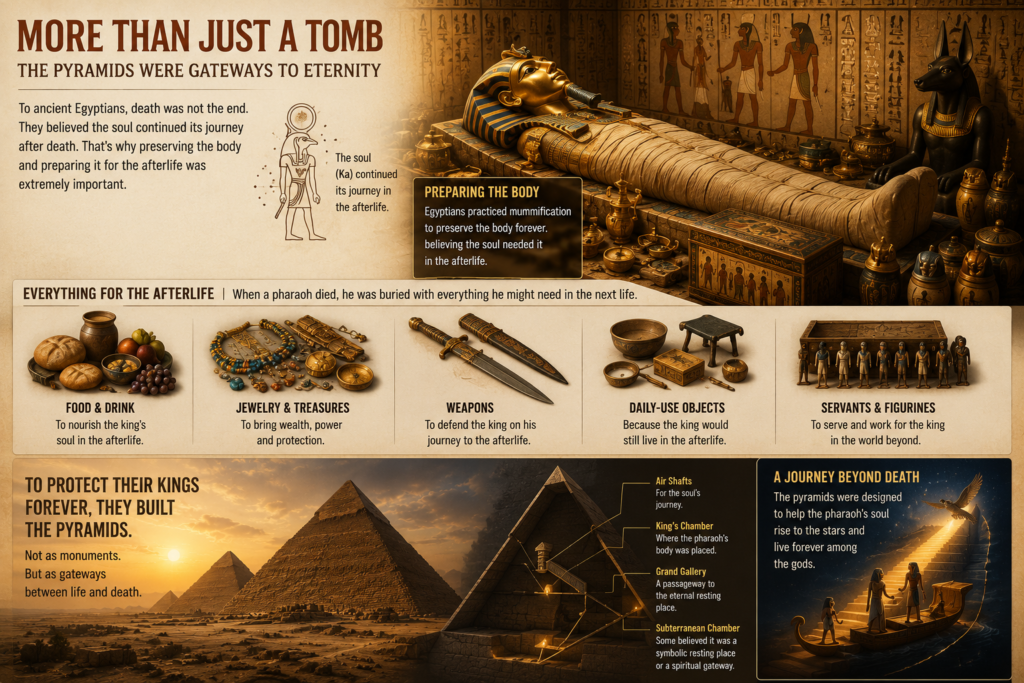
Food, jewelry, treasures, weapons, even daily-use objects were placed beside the body because they believed the king would still need them in the afterlife. And to protect these royal bodies forever… they built the pyramids. Not as monuments. But as gateways between life and death.
The Construction Mystery That Still Feels Impossible
Now this is where the mystery becomes truly unbelievable. The Great Pyramid stood around 481 feet tall when it was completed. For nearly 3,800 years, it remained the tallest structure on Earth. Think about that for a second. Thousands of years passed… civilizations rose and disappeared… and still nothing taller existed. But what shocks researchers even more is the speed of construction. Historians estimate the pyramid may have been completed in around 20 years.
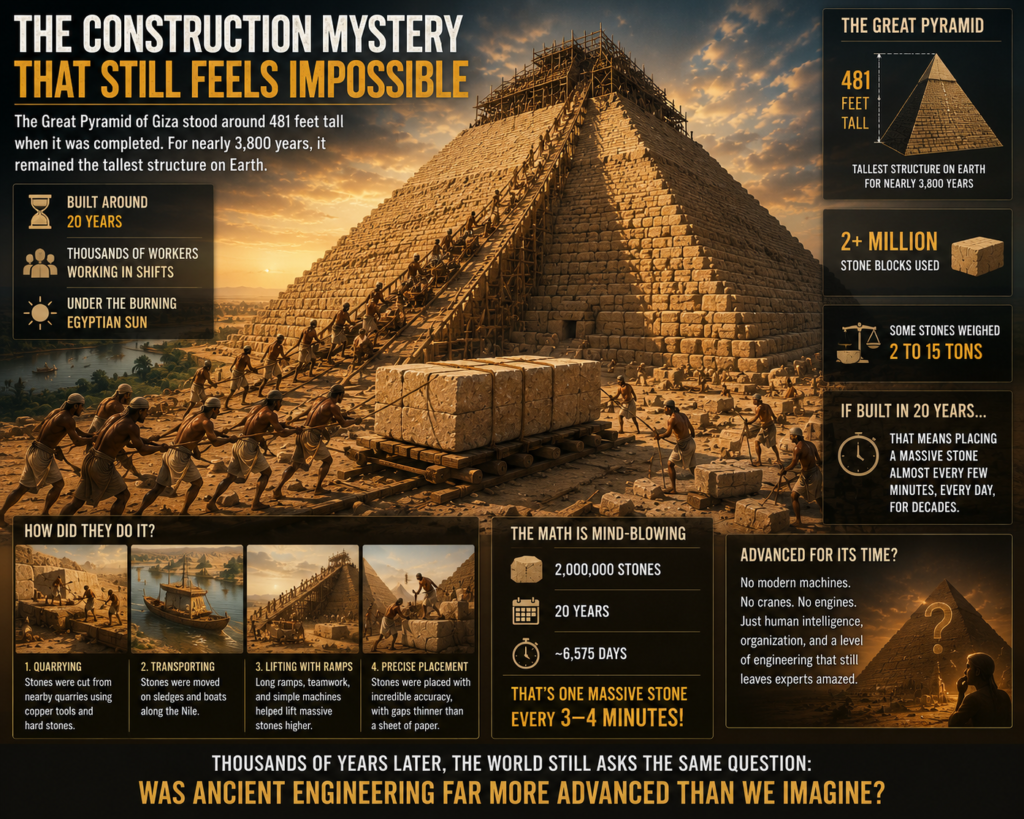
That sounds normal until you do the math. If millions of stones were placed within that time, workers would have needed to position massive blocks almost every few minutes… every single day… for decades. Under the burning Egyptian sun. That’s the part where people stop and wonder: Was ancient engineering far more advanced than we imagine?
Moving Giant Stones Without Modern Technology
One of the biggest mysteries was transportation. How do you move stones weighing several tons without trucks or machines? For years, researchers struggled to answer that question. Then something fascinating was discovered. Ancient Egyptians may have transported many stones using the Nile River itself. Boats and wooden rafts carried heavy limestone blocks close to the pyramid site.
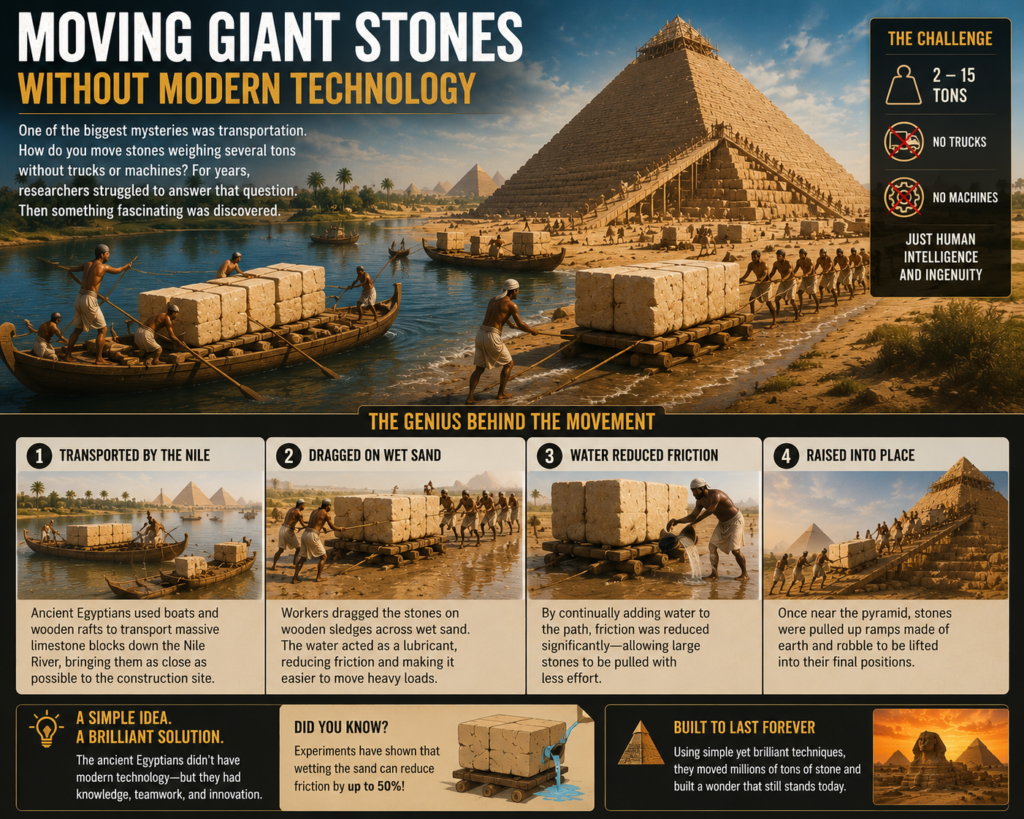
But the real genius came after that. Workers dragged the stones across wet sand using wooden sledges. And surprisingly, adding water reduced friction and made the stones easier to pull. Such a simple idea. Yet brilliant enough to help build one of the greatest structures in human history.
The Precision Is Almost Unreal
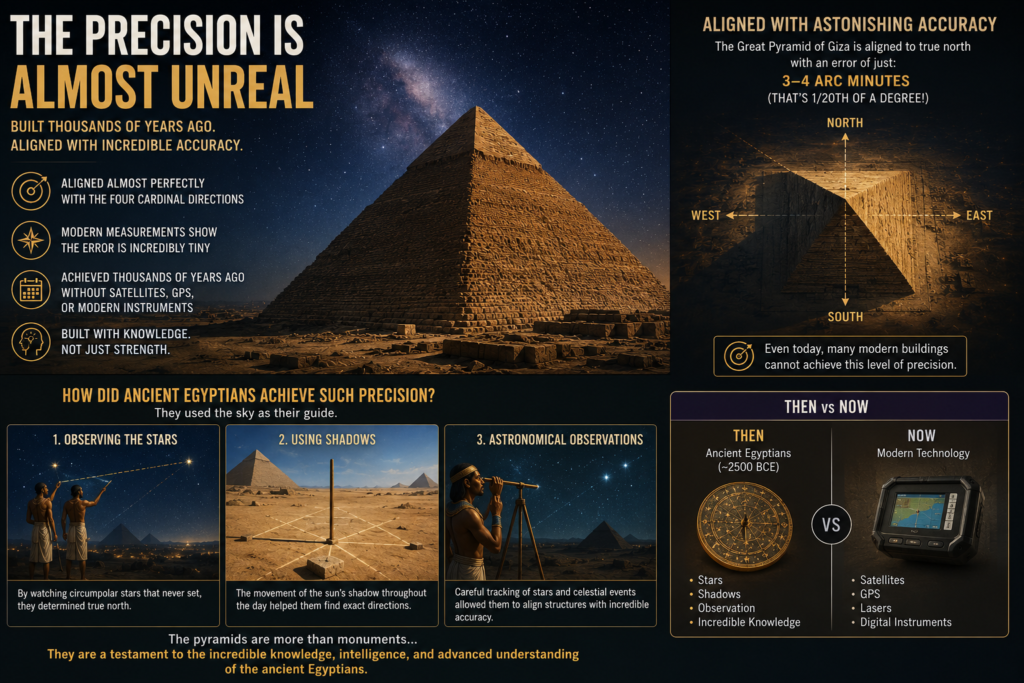
Here’s where things become even stranger. The pyramids are aligned almost perfectly with north, south, east, and west. Not “close enough.” Almost perfectly. Even modern measurements show the error is incredibly tiny. And remember… This was achieved thousands of years ago without satellites, GPS, or modern instruments. Researchers believe Egyptians may have used stars, shadows, and astronomical observations to achieve this level of accuracy. Which honestly makes the entire story even more impressive. Because it means the pyramids weren’t just built with strength. They were built with knowledge.
The Pyramids Still Haven’t Revealed All Their Secrets

What makes the pyramids truly fascinating is that the mystery still isn’t over. Even today, scientists continue scanning the pyramids using advanced technology. And recently, hidden chambers and unknown spaces were discovered deep inside the structures. Some theories online claim there may even be massive underground systems beneath the pyramids. Others believe those claims are exaggerated. But one thing is undeniable: We still don’t fully understand everything hidden inside these ancient monuments.
And maybe that’s exactly why the pyramids continue to capture human imagination after thousands of years. Because no matter how much we discover… they still refuse to give away all their secrets.